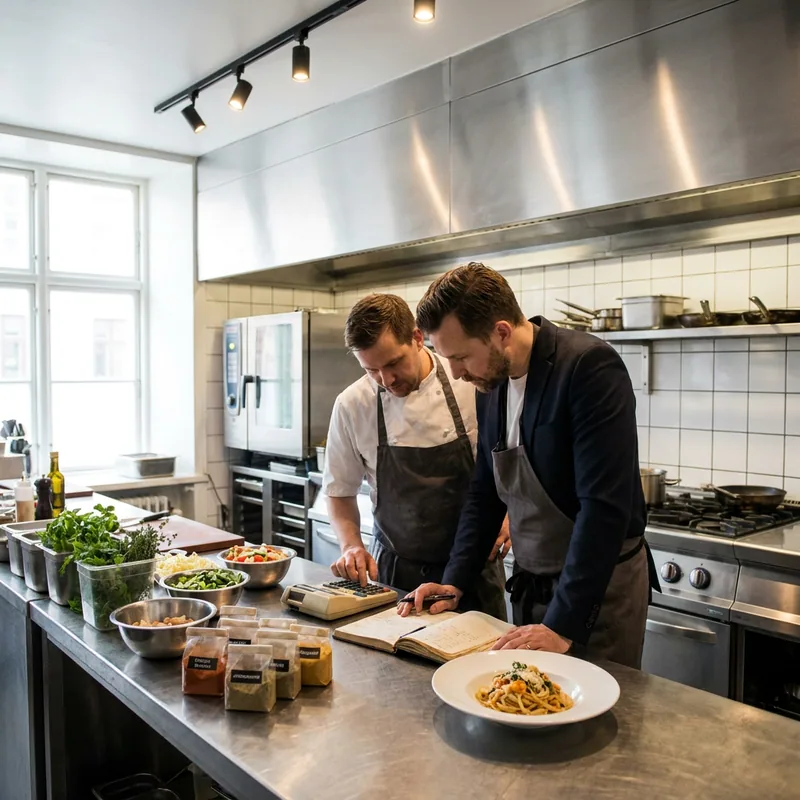
Restaurant food cost is one of the most important numbers in any food business. It shows how much you spend on ingredients to produce the dishes you sell, and it directly affects pricing, margins, and daily profitability. If your food cost is too high, even a busy restaurant can struggle to make money. In the UK and Ireland, many chefs talk about GP (gross profit) instead of food cost: it is the other side of the same sum. The food costing formula below works for a single dish, which is menu costing, and for the whole kitchen over a week or a month.
The good news is that food costing does not need to be complicated. With a few basic formulas and a consistent process, you can measure your true food cost, set smarter menu prices, and spot where profit is being lost.
What is restaurant food cost?
Restaurant food cost is the cost of the ingredients used to prepare and serve food, compared with the revenue generated from food sales. It is usually tracked as a percentage.
In simple terms, food cost answers this question: for every euro, pound, or dollar you earn from food sales, how much goes toward the ingredients? If a dish sells for 20 and the ingredients cost 6, the food cost percentage for that dish is 30%.
Restaurant food cost formula
The standard food cost percentage formula is:
FOOD COST PERCENTAGE FORMULA
Ingredient Cost ÷ Food Sales × 100
This formula can be used in two main ways:
- Per menu item - to check whether an individual dish is priced correctly
- For the whole restaurant - to monitor overall food cost performance over a day, week, or month
- Per dish example
A pasta dish costs 4.50 in ingredients and sells for 15.00:
4.50 ÷ 15.00 × 100 = 30%
- Whole restaurant example
Food spend of 9.000 against food sales of 30.000:
9.000 ÷ 30.000 × 100 = 30%
Rather have it done for you?
Your Brand Ambassador can do everything for you, and our in-house designers make your files print-ready. Or see your brand on everything first, in Studio.
How to calculate actual food cost
To understand real performance, many operators track actual food cost over a set period. This gives a clearer view than looking only at individual recipes.
ACTUAL FOOD COST FORMULA
Beginning Inventory + Purchases − Ending Inventory = Cost of Food Used
Cost of Food Used ÷ Food Sales × 100 = Actual Food Cost %
WORKED EXAMPLE
- Beginning inventory: 5.000
- Purchases: 12.000
- Ending inventory: 4.000
5.000 + 12.000 − 4.000 = 13.000 cost of food used
With food sales of 40.000: 13.000 ÷ 40.000 × 100 = 32,5%
What is a good food cost percentage for a restaurant?
There is no single ideal number for every concept, but many restaurants aim for a food cost percentage somewhere around 28% to 35%. The right target depends on your menu, service model, location, and price point. A good food cost percentage is not just low — it needs to be sustainable for your concept while leaving enough room for labour, rent, packaging, utilities, and profit. Branded food packaging starts from €0,060 per piece: see custom printed food packaging.
| FOOD COST PERCENTAGE | GENERAL INTERPRETATION |
|---|---|
| Under 28% | Can be strong, but check that pricing, portion size, and perceived value still make sense |
| 28% to 35% | Common target range for many restaurants |
| Over 35% | May signal pricing issues, waste, theft, over-portioning, or rising supplier costs |
Why food cost matters so much
Food cost affects more than menu pricing. It influences purchasing decisions, stock control, promotions, and how much profit you keep from each cover or order. If you do not know your food cost, it becomes much harder to answer basic business questions such as:
- Which dishes are actually profitable?
- Should prices be increased?
- Are portion sizes too generous?
- Is waste eating into margin?
- Are supplier price changes hurting the business?
Tracking food cost regularly helps turn those questions into measurable actions.
Menu costing: how to price menu items using food cost
Menu costing starts with the full ingredient cost of a dish. Once you know that number, you can estimate a selling price based on your target food cost percentage.
SELLING PRICE FORMULA
Ingredient Cost ÷ Target Food Cost Percentage = Selling Price
EXAMPLE
A dish costs 5.00 to make. Target food cost is 30%:
5.00 ÷ 0.30 = 16.67 minimum selling price
This is a useful starting point, but pricing should also consider your market, portion expectations, competition, and the overall role of the dish on the menu. For proven tactics that protect margin without hurting demand, see menu pricing psychology. Presentation also matters: menu design psychology can guide guests toward high-margin items and reduce the impact of food cost.
Common reasons restaurant food cost gets too high
When food cost rises unexpectedly, the problem is often not just one factor. It is usually a mix of pricing, operations, and purchasing issues.
- Over-portioning - small inconsistencies at service quickly add up across covers
- Waste and spoilage - poor rotation, prep loss, or unsold stock increase cost without generating revenue
- Incorrect recipe costing - dishes may be priced using outdated ingredient costs
- Unrecorded comps or staff meals - food leaves the kitchen without being reflected properly in sales
- Theft or inventory errors - stock usage appears higher than expected
- Supplier price increases - margins shrink if selling prices stay the same
- Low-margin delivery sales - app fees and packaging costs can squeeze profitability even when food cost looks acceptable on paper
Simple ways to improve food cost control
Better food cost management usually comes from consistent habits rather than one major change.
- Cost every recipe accurately - include all ingredients, garnishes, sauces, and sides
- Update costs regularly - ingredient prices can change quickly and silently erode margin
- Standardise portions - use clear specs and measuring tools so every plate is consistent
- Count inventory consistently - weekly counts often give better control than monthly counts alone
- Track waste - record spoilage, overproduction, and returned plates so losses are visible
- Review menu mix - use menu engineering to promote dishes that combine popularity with healthy margin
- Audit purchasing - compare suppliers, order sizes, and usage patterns regularly
Food cost, prime cost, and the 30/30/30/10 rule
You may have seen the 30/30/30/10 rule for restaurants. It is a rough budgeting model that divides revenue into four categories.
30%
Food cost
30%
Labour cost
30%
Overhead
10%
Profit
This is only a rule of thumb, not a fixed standard. Real restaurant cost structures vary by concept and market. Still, it highlights an important point: food cost should never be viewed in isolation. A restaurant with a slightly higher food cost may still perform well if labour and overhead are under control.
That is why many operators also track prime cost — the combined total of food cost and labour cost — which gives a broader picture of operating efficiency. This sits alongside other restaurant marketing metrics owners may monitor.
A practical approach to restaurant food costing
If you want a manageable system, start with these basics. Even a simple spreadsheet works if the information is current and used consistently — the key is not the format but the discipline behind it.
YOUR WEEKLY FOOD COSTING ROUTINE
- Count inventory at the same time each week
- Record all food purchases accurately and promptly
- Cost every core menu item including garnishes and sides
- Set a target food cost percentage that fits your concept
- Compare actual food cost against the target each week
- Adjust pricing, portions, or purchasing where needed
Frequently asked questions
How much should food cost in a restaurant?
Many restaurants target a food cost percentage between 28% and 35%, but the right number depends on concept, menu style, and pricing strategy. A good target is one that supports both competitiveness and profit.
What is the food cost of a restaurant?
The food cost of a restaurant is the amount spent on ingredients to produce the food sold. It is often measured as a percentage of food sales so operators can track profitability more clearly.
How much does a typical restaurant meal cost?
There is no fixed average that applies everywhere because meal prices vary widely by location, service style, and concept. For costing purposes, what matters most is whether the selling price covers ingredient cost and leaves enough margin for other operating expenses.